

When people think of Indonesian furniture, they often picture intricately carved teak chairs from Jepara, round “Batavia” or Burgomaster chairs, or elegant rattan pieces in resorts and villas. Behind these familiar forms lies a long, complex history that connects Javanese port cities, Dutch trading houses, Javanese royal courts, and even the Dutch trading post in Nagasaki, Japan.
In “History of Indonesian Furniture”, Hideo Izumida traces how Western furniture entered Indonesia through the Portuguese and the Dutch East India Company (VOC), how it was adopted by Javanese courts and how the woodworking town in Java grew into a major furniture hub that still serves global markets today.
Indonesia’s Natural Resources and Early Woodworking Traditions
Long before European ships appeared in Southeast Asian waters, communities across the Indonesian archipelago were already highly skilled in working with wood and plant fibers. Early kingdoms made extensive use of carved wood for royal thrones and benches in palace complexes, chests and cabinets to store textiles and ceremonial objects, as well as structural and decorative elements in traditional houses, laying the foundation for the rich furniture and carving traditions that would later develop.
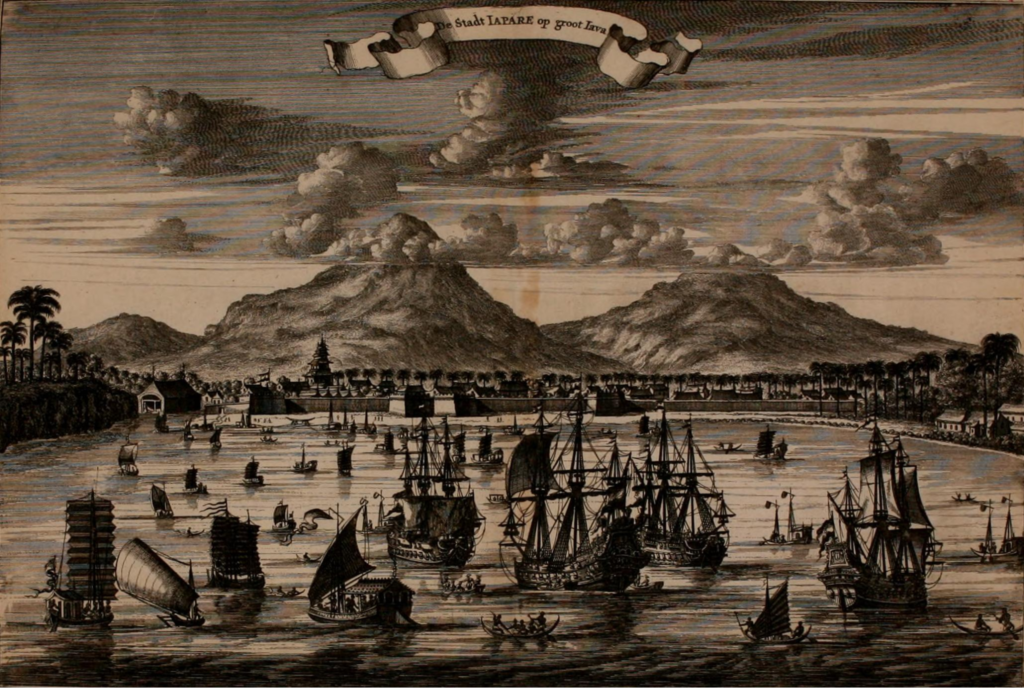
Indonesia’s position as the world’s third-largest tropical rainforest area, rich in teak, mahogany and other hardwoods, later made it a natural base for a large-scale furniture industry. Source
VOC Batavia and Hybrid Baroque Furniture
Batavia as a Colonial Showroom
In the early 17th century, the Dutch East India Company (VOC) took control of Jayakarta on Java’s western coast, renamed it Batavia, and turned it into its administrative and trading headquarters in Asia. Along with soldiers and officials, the VOC brought engineers, masons, carpenters, and furniture makers to build and maintain the castle, warehouses, and residences. Although early illustrations of Batavia mostly highlight streets and buildings, later research shows that behind these façades there emerged a distinct Baroque and Rococo furniture culture in the 17th–18th centuries, characterized by tall armchairs with sculpted backs and twisted legs, richly carved tables, sofas, cupboards, and desks, and the extensive use of tropical hardwoods such as mahogany and teak instead of European oak or walnut. Because European timbers were not available locally, much of this furniture was produced in Asia, often in Java itself, for European residents living in Batavia.
Burgomaster Chairs and Localisation
Among the most striking pieces are the round, many-legged chairs later known as Burgomaster chairs:
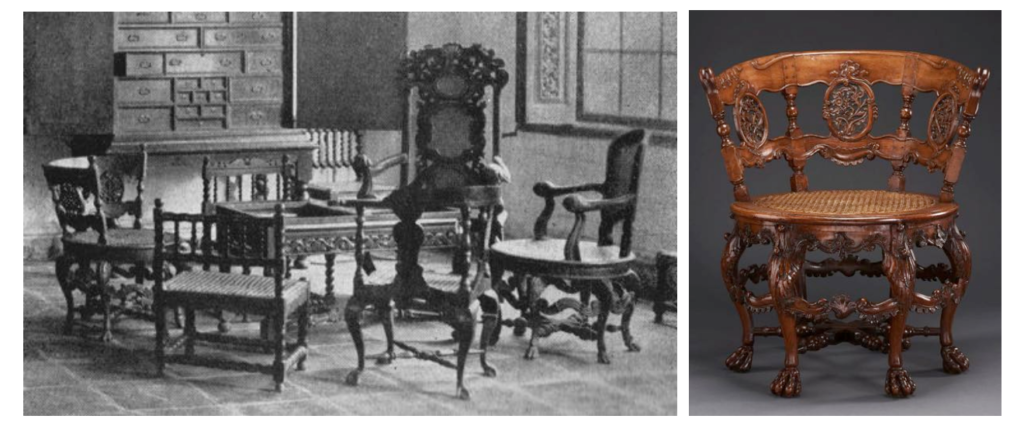
According to Izumida, these chairs were produced in significant numbers during the VOC period and exported to Europe, where they acquired their Dutch name. Examples survive today in museums in Singapore and Surakarta. Source
The VOC also employed Chinese immigrant craftsmen in Batavia. Their work helped localise Western designs, and over time, hybrid types emerged, such as the Betawi chair, which combines Western chair structures with Chinese stylistic elements. Source
Political upheavals, including the anti-Chinese violence of 1741, pushed many Chinese craftspeople away from Batavia. At the same time, teak replaced ebony as a main furniture wood, and the woodworking base shifted increasingly toward Central Java, especially Jepara
Western Furniture in the Courts of Central Java
Mataram, Surakarta, and Yogyakarta
In the 18th century, the VOC extended its influence from the coastal trading cities into the interior of Java, particularly the Mataram kingdom, eventually contributing to its division and the establishment of the royal courts of Surakarta and Yogyakarta. Paintings and palace collections show that these courts began to adopt Western furniture: coronation scenes depict Javanese rulers seated on Baroque-style chaise longues beneath traditional pendopo roofs, while palace museums display groupings of Burgomaster chairs alongside Louis XV-style armchairs. In this context, the chairs were far more than functional objects
Furniture as Political Stage Set
Izumida describes Western chairs in the royal courts as “political stage props”: they appeared in key public rituals, audiences, and diplomatic events. Source
The choice of style signaled alignment with European powers, while their placement in traditional spaces such as the pendopo visually expressed a hybrid order, Javanese in architecture but European in seating and etiquette.
The “Raffles Chair” and 19th-Century Transformations
British Interlude and New Design Influences
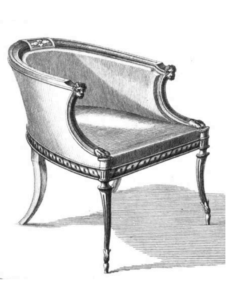
During the early 19th century, British rule under Thomas Stamford Raffles briefly replaced Dutch administration in Java, coinciding with the spread of Neo-Classical furniture designs developed by British designers such as George Hepplewhite and Thomas Sheraton. Illustrations and paintings from this period show chairs in Java with straight, tapered legs, light and rectilinear frames, and subtle carved ornament in place of the heavier Baroque carving of earlier eras. Izumida links these pieces to Sheraton’s influence and notes that one particular model became known locally as the “Raffles chair,” a design that is still produced in Jepara and Klaten today for both domestic use and export markets.
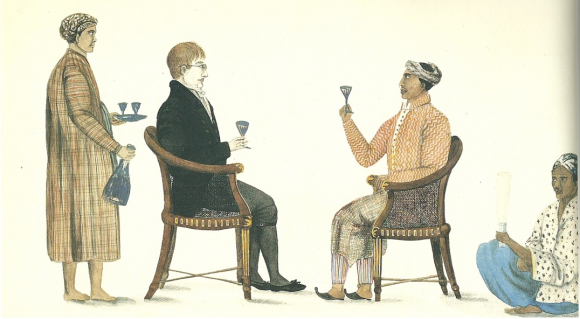
Izumida links these to Sheraton’s designs and notes that a particular model became known locally as the “Raffles chair.” Remarkably, similar chairs are still produced in Jepara and Klaten today for domestic and export markets. Source
Jepara’s Furniture System in the Late Colonial Period
By the late 19th and early 20th centuries, Jepara had firmly established itself as a major furniture manufacturing center. Historical accounts describe a system of small workshops supplying larger traders or export houses, producing both standardized models such as the Raffles chair and more elaborately carved pieces. Figures like Raden Ajeng Kartini also played an important role, actively promoting Jepara’s carving industry as a means to support local livelihoods and advance women’s education. This period marks a clear transition from purely artisanal production for royal courts and colonial elites to a more organized furniture industry geared toward broader domestic and overseas markets.
From Independence to Modern Global Industry
Expansion, Rattan, and Export Growth
After Indonesian independence in 1945, furniture production expanded significantly and entered a new phase of development. One of the most striking trends was the rapid growth of rattan furniture, with Indonesia emerging as one of the world’s leading exporters of rattan chairs and tables in the 1970s–1980s. At the same time, small and medium-sized enterprises spread across key centers such as Jepara, Cirebon, and other regions, increasingly orienting their production toward international markets. Design-wise, manufacturers began to combine carved teak furniture with modern minimalist lines, often integrating rattan or bamboo elements to create versatile pieces suitable for both indoor and outdoor use, helping Indonesian furniture remain competitive and visually distinctive in the global arena. Source
Sustainability, Certification, and Design Innovation
In recent decades, environmental concerns and international regulations have pushed Indonesian furniture producers to adopt wood legality and sustainability certifications such as SVLK and, in some cases, FSC. At the same time, companies and design studios have begun to blend traditional carving and weaving with contemporary minimalism, positioning Indonesian furniture as a premium choice for hotels, resorts, and high-end residential projects. Digital platforms and online catalogs now allow makers in Jepara and other Javanese centers to reach clients across the globe. As a result, Indonesian furniture continues to evolve and modernize, yet it still carries clear traces of the VOC era, the Javanese courts, and the long history of hybrid Indo-European design so carefully described in Izumida’s work.
Conclusion
The history of Indonesian furniture is not a simple story of local tradition or colonial imitation, but a layered narrative in which indigenous woodworking and carving traditions in Java and other islands provided a strong technical foundation; VOC Batavia, Portuguese and Dutch craftsmen, and Chinese artisans created hybrid European–Asian furniture types such as the Burgomaster and Betawi chairs; Javanese royal courts used Western chairs as symbols of power and cultural negotiation; and British and later Dutch influences introduced Neo-Classical and Regency forms, leading to enduring models like the “Raffles chair.”
Over time, towns like Jepara transformed from local craft centers into globally recognized industrial clusters supplying teak and rattan furniture to the world, and today this legacy is carried forward by contemporary manufacturers such as Muebles Asia. By understanding this history, readers and buyers can better appreciate why a seemingly simple chair from Jepara, or a rattan lounge chair in a hotel lobby, is actually the product of centuries of cultural exchange, political change, and artisanal skill.